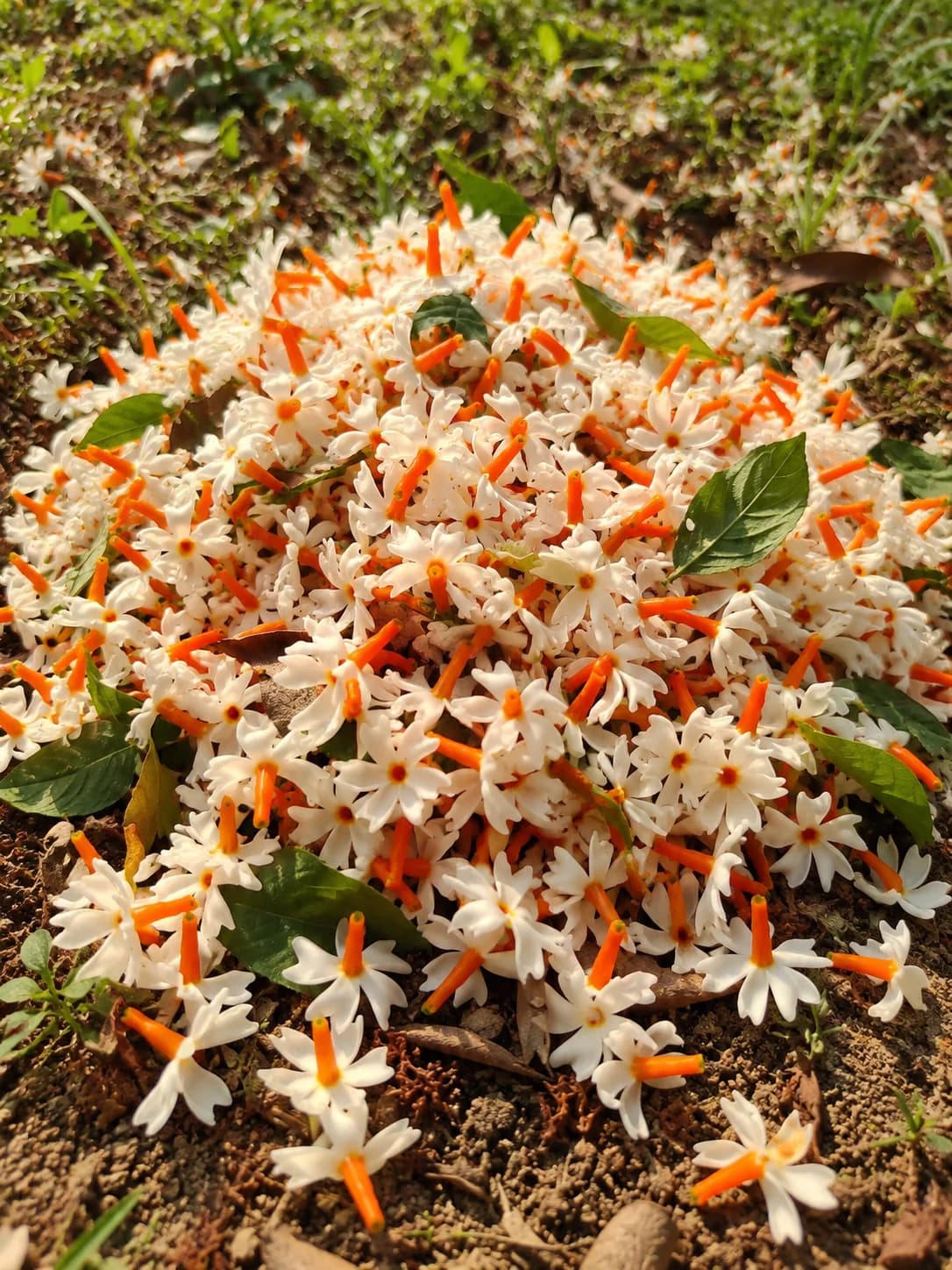
The journey from a fresh flower to a fragrance is not always straightforward. Some botanical materials can be distilled with established methods, while others require preliminary testing to understand their extraction potential.
At Kannauj Attar, we are exploring the possibilities of Harsingar flowers, also known as Parijat or Night Jasmine, for the development of a distinctive fragrance material and fragrant floral water.
Our planned process begins with laboratory-scale testing to estimate the oil yield. Once the initial results have been evaluated, the next stage is traditional Deg-Bhapka distillation.
This article explains the stages of this work, why testing matters and how attar differs from floral water.
Harsingar: A Flower with a Distinctive Identity
Harsingar (Nyctanthes arbor-tristis) is widely known in India as Parijat. Its white petals and orange centre make it easy to recognise, while its fragrance has inspired interest in botanical and floral materials.
For natural perfumery, the flower's scent is an important starting point. But the scent of a fresh flower does not tell us exactly what an extracted oil or distilled water will smell like.
A perfumer must consider how the flower behaves during extraction, which aromatic compounds are carried through the process and whether the resulting material has the quality and character needed for its intended use.
This is why Harsingar fragrance development deserves careful observation rather than assumptions.
Stage 1: Laboratory Testing Before Traditional Distillation
The first stage of our Harsingar project is laboratory-scale testing.
Before investing in a larger batch, we want to estimate how much extractable oil the selected flowers may yield under the chosen test conditions.
This stage is intended to provide practical information about:
- The quantity of aromatic material obtained from the test sample.
- The approximate yield under those specific conditions.
- The smell and general characteristics of the resulting material.
- The feasibility of moving to a larger trial.
- Questions that need further investigation before traditional distillation.
The results of this preliminary test will guide our next decisions. They will not automatically predict the yield of a full-scale Deg batch, because conditions and raw materials may differ.
Scientific studies of Nyctanthes arbor-tristis describe variation in its extracted essential oil and chemical composition. These findings reinforce the need to evaluate the actual material and extraction method rather than relying on a single published number.
Reference: Scientific review of Nyctanthes arbor-tristis extraction methods.
Stage 2: Evaluating the Fragrance Material
Oil quantity is only one part of fragrance development. The quality and character of the material are also important.
After a laboratory trial, the resulting material needs to be assessed for its aroma and suitability for further development.
Important questions include:
- Does the material have a recognisable Harsingar character?
- Is the aroma suitable for the intended perfumery application?
- Is the quantity obtained sufficient to justify another trial?
- Does the material require further evaluation or refinement?
The answers depend on the actual test results. We will not claim a particular yield, purity level or fragrance profile before the material has been evaluated.
Stage 3: Traditional Deg-Bhapka Distillation in Kannauj
Once the preliminary testing has provided sufficient information to proceed, the next stage is to investigate traditional Deg-Bhapka distillation.
The Deg-Bhapka system is closely associated with Kannauj's traditional attar-making heritage. It uses a distillation vessel, a connection that carries vapour and a receiving vessel in which the vapour can cool and condense.
At a simplified level, the process follows these stages:
- Prepare the flowers: The selected botanical material is inspected and prepared for the trial.
- Load the Deg: The material and water are placed in the distillation vessel according to the process being tested.
- Apply controlled heat: Heating generates vapour that carries aromatic constituents.
- Transfer the vapour: The vapour travels through the connecting system towards the receiver.
- Condense the vapour: Cooling allows the vapour to condense.
- Collect and evaluate: The resulting material is collected and assessed according to its intended use.
The precise setup and receiving medium depend on the process and product. Traditional attar production can involve capturing aromatic material in a receiving oil, whereas a floral-water process focuses on the water-based distillate.
For more detail on our initial testing approach, read Why Harsingar Attar Development Begins with Oil-Yield Testing.
Stage 4: Understanding Harsingar Attar
Attar is a fragrance material associated with traditional Indian perfumery. In the Deg-Bhapka tradition, aromatic vapours can be condensed into a receiving oil, creating a fragrance material whose character depends on the botanical material, receiving medium and processing conditions.
A Harsingar attar project therefore needs to answer more than whether the flower has a pleasant scent.
It must establish whether the selected process produces a suitable aromatic material and whether the resulting fragrance has the qualities expected of the intended product.
Customers should also be able to distinguish a traditional attar from a fragrance oil, a perfume compound or a water-based distillate. These materials are not automatically equivalent.
Stage 5: Understanding Harsingar Floral Water
Floral water, often described as a hydrosol when produced through an appropriate distillation process, is different from concentrated attar.
A water-based aromatic distillate may carry a different balance of aromatic constituents from the oil phase. Its scent, appearance, stability and intended use depend on the material and processing method.
If our Harsingar trials produce a suitable floral water, its characteristics will need to be assessed separately from the attar.
Before a floral water is offered for sale, its intended use, quality, storage requirements and any necessary testing should be established. It should not be marketed as safe for drinking, skin application or therapeutic use without the relevant product-specific basis and compliance.
Why Harsingar Attar and Floral Water May Be Special
The potential interest in Harsingar fragrance comes from the combination of a distinctive flower, the challenge of extracting its aromatic material and the opportunity to study it through Kannauj's perfumery tradition.
There are several reasons the development process is worth following.
1. A less commonly encountered floral fragrance
Harsingar is familiar as a flowering plant, but a flower's familiarity does not mean that its extracted fragrance is widely available in a standardised commercial form.
The availability and quality of a genuine Harsingar-derived fragrance should be verified from the actual product rather than inferred from the botanical name alone.
2. Extraction feasibility matters
If the recoverable aromatic material is limited under a particular process, the quantity of flowers, labour and production time required may make the product more challenging to develop.
Laboratory-scale testing helps investigate this question before moving to larger-scale work.
3. Traditional craft and technical evaluation work together
The Deg-Bhapka process reflects a long-standing perfumery tradition, while laboratory testing can provide additional information about extraction yield and material characteristics.
Combining practical process knowledge with appropriate testing helps guide development decisions. Neither replaces the need to evaluate the finished product.
4. The final fragrance must earn its place
The purpose of the project is not to label a flower as rare simply to make it sound luxurious. The goal is to understand what can actually be produced, how the resulting material smells and whether it meets the quality requirements for a finished product.
How Kannauj Attar Approaches the Development Process
Our approach to Harsingar is to document the work as it progresses.
The current development plan begins with a laboratory trial to estimate oil yield, followed by an assessment of the resulting material. If the findings justify proceeding, the next stage will be a traditional Deg-Bhapka trial.
We aim to explain the process transparently, including the decisions that determine whether the material is suitable for further development.
Where results are available and can be shared, documenting the actual process, test conditions and findings can help customers understand the difference between a fragrance idea and a product that has been successfully developed.
When Will Harsingar Attar and Floral Water Be Available?
The project is in development, and commercial availability depends on the outcomes of the laboratory trials, subsequent distillation work and evaluation of the resulting materials.
We will only be able to describe the final aroma, yield, packaging and product specifications once those details have been established.
To learn about the first stage of the project, visit our companion article: Harsingar Attar: Why We Test the Flowers Before Traditional Distillation.
Frequently Asked Questions
What is Harsingar flower attar?
It refers to an attar developed using Harsingar flowers, also known as Parijat or Night Jasmine. The actual product's ingredients and manufacturing method should be verified from its specifications.
Why is oil-yield testing important?
It helps estimate the quantity of extractable material obtained under specific laboratory conditions and informs whether further development is practical.
Is Harsingar floral water the same as Harsingar attar?
No. Attar is a fragrance material, often involving a receiving oil in traditional distillation, while floral water is a water-based aromatic distillate. They have different characteristics and potential uses.
Is Harsingar attar already available from Kannauj Attar?
The Harsingar project described in this article is in development. Availability should be confirmed after the relevant trials and product evaluation are completed.
Does laboratory testing guarantee the final product's quality?
No single preliminary test guarantees all aspects of a finished product. The final material must be assessed using suitable methods for its intended specification and use.
Conclusion: Following Harsingar from Flower to Fragrance
The journey of Harsingar from a fresh flower to a possible attar and floral water begins with a simple but important question: what can be extracted from the selected flowers, and is the resulting material suitable for perfumery?
By starting with laboratory-scale oil-yield testing and then investigating traditional Deg-Bhapka distillation, Kannauj Attar aims to approach this development with care, transparency and respect for the craft.
Follow our updates to learn more as the trials progress and the fragrance potential of Harsingar is investigated.