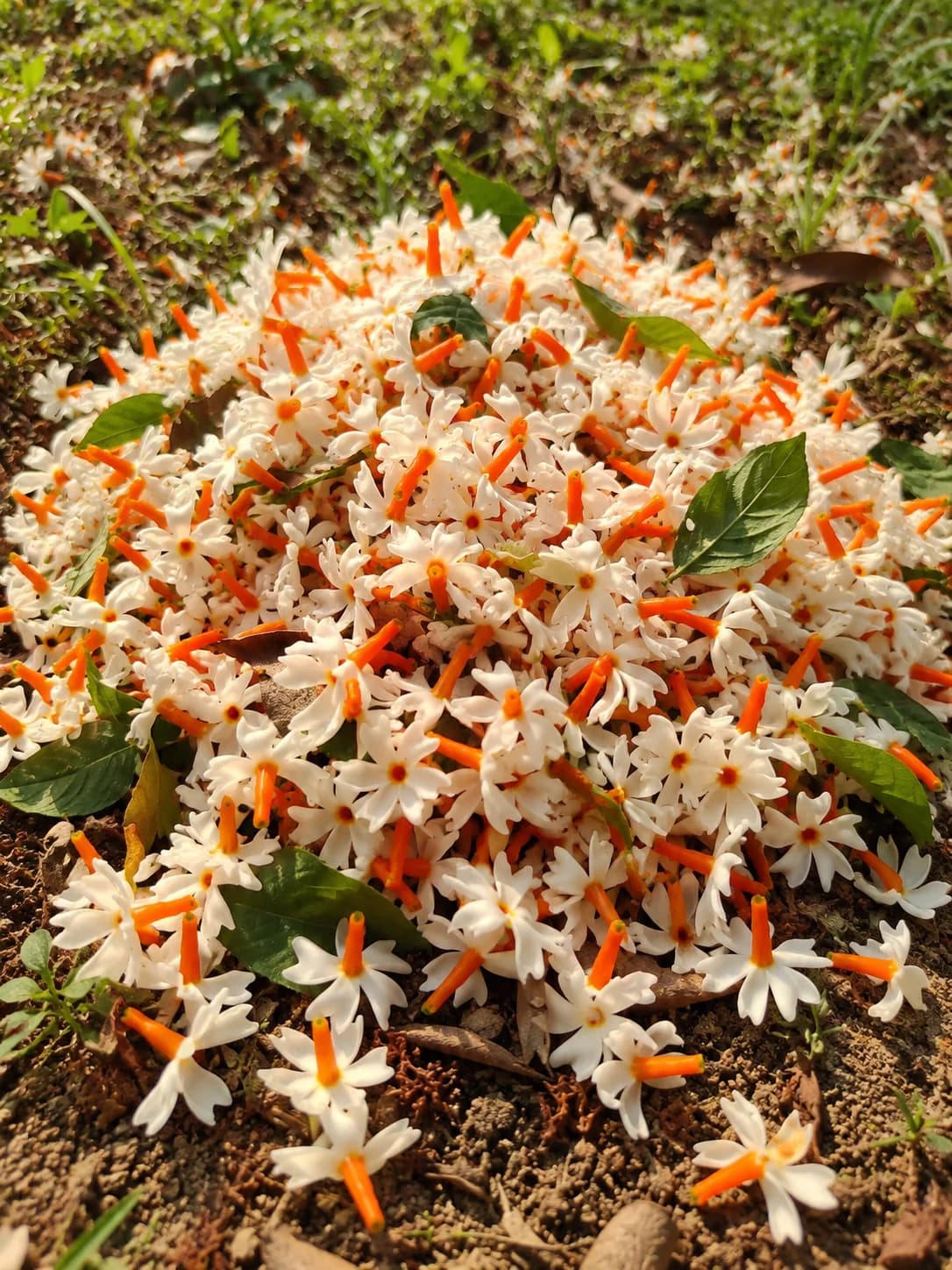
Some flowers are remembered for their appearance. Others are remembered for the fragrance they leave behind. Harsingar, also known as Parijat or Night Jasmine, belongs to the latter category.
Its delicate white petals, orange-coloured centres and distinctive floral aroma have made it a familiar part of India's botanical and cultural heritage. But capturing the character of a flower in a concentrated fragrance is a different challenge from simply enjoying its natural scent.
At Kannauj Attar, we are exploring the traditional perfumery potential of Harsingar flowers through a carefully planned process. Before moving to a full traditional distillation, our first step is to conduct laboratory-scale trials to understand the flowers’ oil yield and extraction feasibility.
This is an important step towards developing Harsingar attar and Harsingar floral water while learning more about the fragrance potential of this special flower.
What Is Harsingar? Understanding Parijat and Night Jasmine
Harsingar (Nyctanthes arbor-tristis) is a flowering plant commonly known in India as Parijat. In English, it is often called Night Jasmine.
The flowers are visually distinctive, with white petals surrounding an orange centre. Their delicate fragrance is one reason the plant attracts interest from people who appreciate flowers, botanical materials and natural perfumery.
For a perfumer, however, a flower's natural smell is only the beginning. The important question is how much of its aromatic character can be captured through a suitable extraction process, and what the resulting material will smell like.
The aroma of the living flower may differ from that of an extracted oil, an attar or a floral water. Each is a distinct material, and each needs to be evaluated on its own merits.
Why Is Harsingar Attar Interesting to Natural Perfumers?
Harsingar is interesting because it presents a combination of a recognisable floral identity and a technical extraction challenge.
Unlike a fragrance made by blending readily available perfume materials, developing a fragrance from a particular flower requires an understanding of the raw material itself.
Several factors may influence the result:
- Flower quality: Freshness, maturity, handling and the condition of the flowers can influence extraction.
- Seasonal availability: The quantity and condition of available flowers can change throughout the flowering season.
- Aromatic composition: Flowers contain different volatile and less-volatile compounds, and not all of them behave identically during extraction.
- Extraction method: Different techniques can produce different yields and different aromatic profiles.
- Processing conditions: Water, heat, time and the handling of the collected material all matter.
This is why the development of a distinctive natural fragrance cannot be judged by the flower's smell alone.
Why We Begin with Laboratory Oil-Yield Testing
Our first step is to study Harsingar flowers at laboratory scale before proceeding to a larger traditional distillation in a Deg.
The purpose of this preliminary trial is to understand the extraction potential of the selected flower material and estimate the oil yield under the tested conditions.
This allows us to investigate a few essential questions:
- How much extractable oil can be obtained from the test quantity of flowers?
- Does the resulting material have a useful and recognisable aromatic profile?
- Is the yield sufficient to justify further development?
- Which processing conditions deserve further investigation?
- What practical considerations should be addressed before scaling up?
The results will help guide our next step. They are not a guarantee that a larger batch will produce an identical yield, because raw materials and processing conditions can vary.
Why does oil yield matter?
Oil yield is important because flower-based fragrance materials can require considerable raw material and processing effort.
If the quantity of recoverable aromatic material is low, producing a concentrated fragrance may require a larger quantity of flowers, more processing time or further technical investigation.
Published research on Nyctanthes arbor-tristis reports variation in essential-oil yield depending on factors such as the material used, its origin and the extraction method. This supports the importance of testing rather than assuming a fixed yield for every batch.
Scientific reference: Research on Harsingar extraction methods and essential-oil yield
Once the preliminary laboratory work provides useful information, the next stage is to investigate traditional distillation using the Deg-Bhapka system.
Deg-Bhapka is associated with Kannauj's traditional perfumery craft. In this method, botanical material and water are heated in the distillation vessel. Aromatic vapours travel towards a receiving vessel, where they cool and condense into the receiving medium.
The process requires practical judgement. The character of the raw material, heat management, condensation and the perfumer's observations all influence the outcome.
For Harsingar, the aim is not simply to produce a liquid. It is to understand whether traditional distillation can capture a fragrance worth preserving and evaluating.
Learn more about the traditional method through our related article: From Harsingar Flowers to Attar and Floral Water.
Harsingar Attar and Harsingar Floral Water: What Is the Difference?
Both materials may originate from the same flowers, but they should not be treated as interchangeable products.
Harsingar attar refers to a fragrance material developed for perfumery. Depending on the method used, a traditional attar may involve aromatic distillation into a receiving oil. Its composition, concentration and aroma need to be assessed from the actual product.
Harsingar floral water is the water-based aromatic distillate associated with a suitable distillation process. It may contain water-soluble and dispersed aromatic constituents, depending on the method and material. Its fragrance and composition differ from those of a concentrated attar.
The precise characteristics of each product must be determined through the actual process and appropriate evaluation. A flower does not automatically produce two commercially suitable products merely because it is distilled.
Why Harsingar Extraction May Be Challenging
A flower can have a beautiful natural fragrance without yielding a large amount of recoverable essential oil.
This distinction is especially important when developing less commonly commercialised floral fragrance materials. Extraction yield, material availability, processing cost and the quality of the final aroma all influence whether a product is practical to develop.
Harsingar's research literature also shows why it is important to distinguish laboratory findings from commercial production. Published results obtained using one extraction method or one source of flowers should not be presented as a guaranteed yield for every production setup.
For our work, the preliminary laboratory stage is a way to make better-informed decisions before committing to traditional distillation.
What Makes Our Development Process Worth Following?
At Kannauj Attar, we want customers to understand not only the final fragrance but also the work behind its development.
Our Harsingar project begins with a practical question: what can the selected flowers realistically yield, and is the resulting aromatic material suitable for further perfumery work?
Our approach includes:
- Studying the flower material before scaling up.
- Conducting a preliminary laboratory trial to assess extraction feasibility.
- Evaluating the resulting aromatic material.
- Investigating traditional Deg-Bhapka distillation as the next stage.
- Assessing the resulting attar and floral water separately.
- Sharing authentic process information as the project progresses.
The results of these stages will determine the final product characteristics. We will not treat an expected yield as a confirmed result or promise a particular fragrance profile before it has been evaluated.
Can You Buy Harsingar Attar or Harsingar Floral Water?
We are working on the development of these Harsingar fragrance materials. Their commercial availability will depend on the results of the extraction trials, the quality of the resulting material and the suitability of the final product.
If you are interested in this project, follow Kannauj Attar for updates on the laboratory stage, traditional distillation and product development.
For anyone interested in the process itself, read our companion article: How Harsingar Flowers May Be Transformed into Attar and Floral Water.
Frequently Asked Questions About Harsingar Attar
Is Harsingar attar the same as Parijat attar?
Harsingar and Parijat are common names for Nyctanthes arbor-tristis. The name used for a fragrance product may vary, so the actual botanical material and extraction method should be confirmed.
Why test Harsingar flowers in a laboratory first?
Laboratory-scale testing helps assess extraction feasibility and estimate oil yield under specific conditions before proceeding to a larger distillation.
Does a strong-smelling flower always produce a high oil yield?
No. The intensity of a flower's natural aroma does not necessarily indicate how much extractable oil it will produce.
What is the difference between Harsingar attar and floral water?
An attar is a fragrance material, often involving aromatic distillation into a receiving oil in traditional perfumery. Floral water is a water-based distillate. Their compositions and uses are different.
Will every batch have the same oil yield?
Not necessarily. Flower condition, source, extraction method and processing conditions may affect the result. A preliminary test should not be treated as a guarantee for every production batch.
Conclusion: Understanding the Flower Before Making the Fragrance
The development of Harsingar attar begins before the Deg is heated. It begins with understanding the flower, studying its extraction potential and evaluating whether its aromatic material is suitable for further work.
By starting with laboratory-scale oil-yield testing and then investigating traditional Deg-Bhapka distillation, we aim to approach Harsingar fragrance development with both practical care and respect for Kannauj's perfumery heritage.
Follow Kannauj Attar to learn more about the process, the experiments and the fragrance materials we are working to develop.